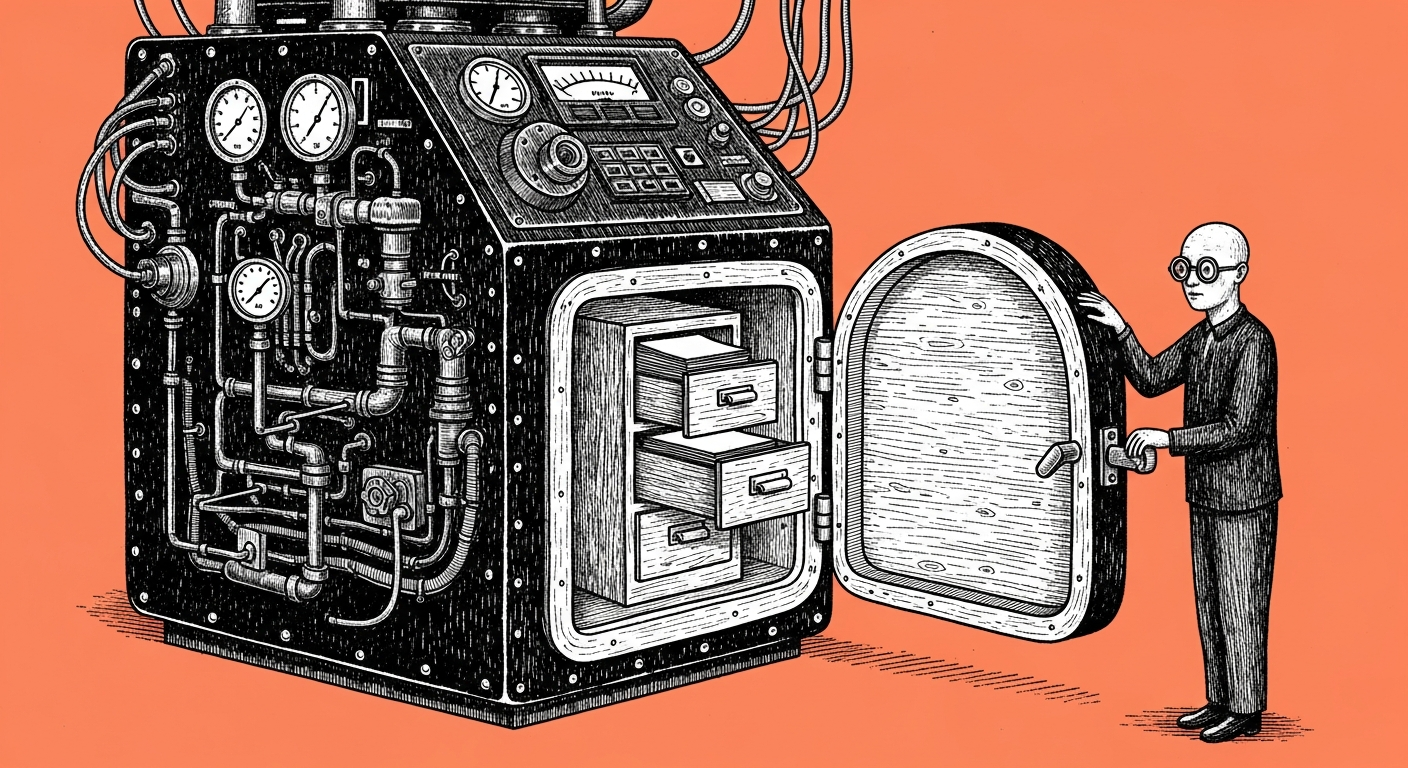
Everything that looks like a spaceship control panel is really six simple folders, and all of them are made from the same one thing: text files. The three foundation folders are A for the agents, B for the brain, C for the core. The three working folders are T for tools, O for outputs, M for memory. Look at the letters in order: A-B-C-T-O-M. The last three spell Tom. And that is exactly the point, the system is Tom laid out into files, and in your own system it is simply you: the one who sets the direction and decides.
This confusion lands on almost everyone who finishes the workshop, and I hear it in the first steps more than any other question. The complexity you feel is a sensation, not a structure. The moment you break it into rooms, the system suddenly looks like a tidy filing cabinet instead of intimidating code. And that holds whether you see it inside Obsidian or in ordinary folders on your computer, it is the exact same system, only a different view.
A is your team: a folder where every agent has a single role file, who they are and what they are allowed to do. B is the shared brain: what the business knows, the decisions that were made, the projects running right now. C is the core: the identity, the voice, and the way things are done around here, a bit like a short constitution. And the three working folders fill themselves as you go: T the tools (scripts and skills), O the outputs (everything shipped and published), M the memory (the work logs and patterns that build up over time). At the start you live in the three foundation rooms, ABC. The rest fills up almost on its own as you work.
The thing that surprises people with us most is that C, "the core of everything," is usually the shortest folder: a few files about voice and values, and that is it. The identity is small, the knowledge grows over time. We had a workshop graduate who got stressed because she found similar files in two places and thought she had duplicated something (she had not, a tool simply lives in the tools room and identity lives in the core, each thing in its own room).
So instead of trying to grasp all of it at once, open the three foundation rooms and ask one question about each. Within five minutes the structure stops looking like a spaceship and starts looking like a house you already know.
A prompt, on the house
I want to understand the structure of my system at eye level, with no jargon.
Go over my main folders, and explain each one to me in a single line:
1. A, the agents: who my team is, and how many role files are there.
2. B, the brain: what knowledge and decisions are stored, and what matters most for me to know.
3. C, the core: what defines the identity and the voice, and why it is short.
End with one sentence: which room I should strengthen first, and why.
Do this once, and you will find you did not build a monster. You built an orderly house, and all that is left is to keep it tidy.